[?] Subscribe To Get Alsaced

XML RSS
Add to Google
Add to My Yahoo!
Add to My MSN
Subscribe with Bloglines


Home
What's New
Site Map
About Me
Contact Suzele
My Services Alsace Travel Plans
Alsace Tours
Genealogy Help
Visitor Contributions Ask a Question
Your Favorites
Alsace Photos
Genealogy
Your Alsace Trip
Traveling to Alsace Flying to France
Train Travel
Where to Go Find a Hotel
Alsace Maps
Bringing the Kids
Cities & Towns Strasbourg
Haguenau
Obernai
Selestat
Munster
Basel
Villages Wissembourg
Cleebourg
Niederbronn
La Petite Pierre
Saverne
Marlenheim
Molsheim
Mutzig
Rosheim
Schirmeck
Ottrott
Barr
Mittelbergheim
Heiligenstein
Andlau
Dambach la Ville
Scherwiller
Kintzheim
Bergheim
Ribeauvillé
Hunawihr
Riquewihr
Mittelwihr
Kientzheim
Kaysersberg
Ammerschwihr
Turckheim
History History
World War One
Languages Learning French
Alsatian Language
Food & Drink Alsace and Food
Wine in Alsace
Alsace Wineries
 

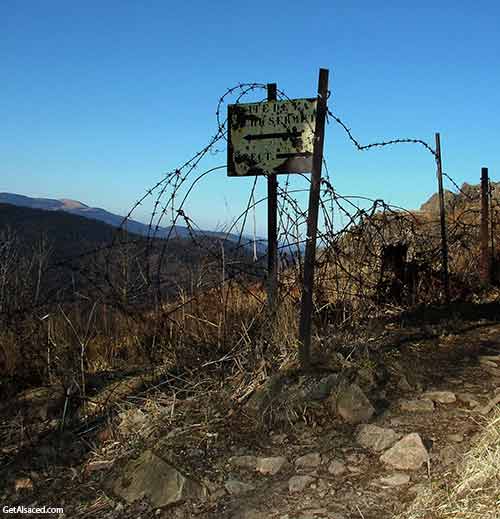
Vieil Armand or Hartmannswillerkopf

One of Alsace's World War One Memorials


Well preserved German World War One trenches at Vieil Armand in Alsace

One of the lesser known World War One memorials is...

Hartmannswillerkopf also known as "Vieil Armand" and "HWK" or "HK"

It was a World War One battlefield in Alsace...

It's unique because it's one of the very few World War One memorials and battlefields in the mountains...

Which means most of the trenches were either built out of stone or carved directly into the rock.

So you can actually see and...

Walk around in the very well preserved World War One trenches.

We spent almost an entire day walking around in the World War One trenches there and...

I doubt we saw them all.

That's just how much is still there!


What Happened at Hartmannswillerkopf?


At Hartmannswillerkopf (or Vieil Armand) there is a pretty good view of Alsace and the surrounding area...

So after war broke out...

The French set themselves up at Hartmannswillerkopf so that they could keep track of what the Germans were up to...

Remember that Alsace at the time was part of Germany so the Vosges mountain range was the France-Germany border then.

Well the Germans wanted to see what the French were up to as well so...

They set themselves up at Hartmannswillerkopf too.

That's when it turned into a fight for the summit on December 30, 1914.

For most of 1915 the French and the Germans attempted to take over the mountain...

And they both succeeded...

Except that when the French managed to push the Germans back, the Germans would then somehow manage to push the French back to where they were before...

And vice versa...

And this continued throughout 1915...

January 8, 1916 was the last major attempt to take the summit of Hartmannswillerkopf.

After that, the battle front in Alsace didn't move much...

Both sides continued to attack the other side but only with grenades, shells, and machine guns...

There were no more men charging into no man's land for the next three years which is one of the reasons these first world war trenches are in such good shape...

The battle front didn't move for three years and...

People were living in the trenches for three years.

Approximately 30,000 men are estimated to have died at Hartmannswillerkopf.


Hiking around Hartmannswillerkopf


This is one of the few World War one memorials in the mountains, so wear your hiking shoes and wear clothing that will cover your legs.

Especially in the summer...

They do cut back some of the plants growing naturally around the trenches but it just grows back.

The memorial building itself is open from April to the beginning of November.

Technically the rest of the memorial site is open year round but...

It is in the mountains...

So I wouldn't go up there until April or later because it's likely that there will be snow and ice.

Personally, I think the spring is a great time to go hiking at Vieil Armand because you can see the trenches better (less plants growing around them) and there are fewer people...

Also there is a little restaurant next to the World War One memorial if you want to sit down and have some hot food or...

You can do what a lot of people do and...

Bring a packed lunch with you and eat it wherever you want and whenever you want.

The summit (where the really big white cross is...) is a nice area to have a picnic.


How do I Get to Hartmannswillerkopf
or Vieil Armand?


The entrance to Vieil Armand or Hartmannswillerkopf World War One memorial in Alsace

The best thing to do is use a GPS and go to Uffholtz...

In Uffholtz, you'll see signs pointing the way to Vieil Armand or Hartmannswillerkopf...

And if you don't have a GPS, you'll find detailed directions below.

In winter sometimes the road is closed because of snow and ice...

Which is just another good reason to wait until spring to enjoy Vieil Armand...


Here's a map of the surrounding area...

If you prefer a paper map, you can get one here...


View Larger Map


Coming from Basel, Mulhouse, Germany

If you are coming from Basel, Mulhouse, Germany or anywhere east of highway A36...

If you're coming from Basel, Germany or anywhere else, go towards Mulhouse...

Take the Lutterbach exit (#15) going towards "Thann" in Mulhouse.

Later you're going to have the choice of going towards "Colmar", take that exit...

Right after you take that exit...

You will start to see exits for the actual village of Cernay...

Look for a brown sign that says "Vieil Armand suivre Uffholtz"

That means take the "Uffholtz" exit to go to Hartmannswillerkopf...

The actual exit name is "Cernay Nord"...

Follow the signs towards Uffholtz...

Once you get to Uffholtz, you will see signs pointing you towards "Vieil Armand" or "Hartmannswillerkopf".

Follow those signs...

It's relatively easy to do...

Alsace marks the way to most of its major tourist attractions (including its World War One memorials) very well.

To get to Vieil Armand or Hartmannswillerkopf, you're going to have to go up into the Vosges mountains. It's not in the foothills, it's very near the summit of this particular mountain peak (which makes sense from a military strategy point of view)...

So just keep following the main road until you see signs for it (and you will be able to see it from the road anyway really).


Coming from Paris or Lyon

If you're coming from Paris, Lyon, or anywhere from the west on highway A36...

Start by going in the direction of Mulhouse.

Take exit 14 "Guebwiller-Thann" in the Mulhouse area...

Later you're going to have the choice of going towards "Colmar", take that exit...

You will start to see exits for Cernay...

Look for a sign that says "Vieil Armand suivre Uffholtz"

That means take the "Uffholtz" exit to go to Hartmannswillerkopf...

The actual exit name is "Cernay Nord"...

Follow the signs towards Uffholtz...

Once you get to Uffholtz, you will see signs pointing you towards "Vieil Armand" or "Hartmannswillerkopf".

Follow those signs...

It's relatively easy to do...

Alsace marks the way to most of its major tourist attractions (including its World War One memorials) very well.

To get to Vieil Armand or Hartmannswillerkopf, you're going to have to go up into the Vosges mountains. It's not in the foothills, it's very near the summit of this particular mountain peak (which makes sense from a military strategy point of view)...

So just keep following the main road until you see signs for it (and you will be able to see it from the road anyway really).


Coming from Colmar or Strasbourg

If you are coming from Colmar, Strasbourg or anywhere north of Mulhouse on highway A35...

Start by going in the direction of Mulhouse.

Take the "Ensisheim" exit and then go towards "Cernay"...

When you start to see exits for Cernay...

Take the "Cernay Centre" exit...

And then follow the signs towards Uffholtz...

Once you get to Uffholtz, you will see signs pointing you towards "Vieil Armand" or "Hartmannswillerkopf".

Follow those signs...

It's relatively easy to do...

Alsace marks the way to most of its major tourist attractions (including its World War One memorials) very well.

Alsace marks the way to most of its major tourist attractions (including its World War One memorials) very well.

To get to Vieil Armand or Hartmannswillerkopf, you're going to have to go up into the Vosges mountains. It's not in the foothills, it's very near the summit of this particular mountain peak (which makes sense from a military strategy point of view)...

So just keep following the main road until you see signs for it (and you will be able to see it from the road anyway really).


Click here to go from "Vieil Armand: World War One Memorials" to "Alsace France in World War One"

Click here to go from "Vieil Armand: World War One Memorials" to the Get Alsaced home page


New! Comments

Have your say about what you just read! Leave me a comment in the box below.

What Do You Need Help With?

Are you having trouble planning all or some part of your Alsace trip or completing your Alsace project?

I'd love to know more about it! Maybe I can help...

Click here to tell me what you want


field of vineyards in autumn in alsace


Let Suzele Plan
Your Alsace Trip for You!

If you don't have the time or the desire to plan your trip to Alsace, let me do it for you...

Go to Alsace Travel Plans


village of andlau in alsace tucked in between the foothills of the Vosges mountains


Your Own Personal Guided Tour in Alsace

Take advantage of my many years of Alsace research and life in Alsace...

See the Alsace that only the locals know about!


A row of ripe dark purple Pinot Noir grapes in a vineyard in Alsace


Have You Been to Alsace Already?

We'd love to hear all about it! Share your photos and discoveries with us here...

Share your Alsace trip with us here


A road leading up to the tiny village of Niedermorschwihr on the wine road in Alsace


Want to Share Your Favorite Photos from Alsace?

See other people's favorite Alsace pictures and share yours with us too...

Click here to share your Alsace photos...


cobblestone lane surrounded by medieval Alsatian houses in Alsace

Got a Question about Alsace?

If you can't find the answers you are looking for, you can ask a question about Alsace here...

Click here to ask a question about Alsace


A nineteenth century chateau up on a hill surrounded by vineyards in Alsace